You must log in or # to comment.
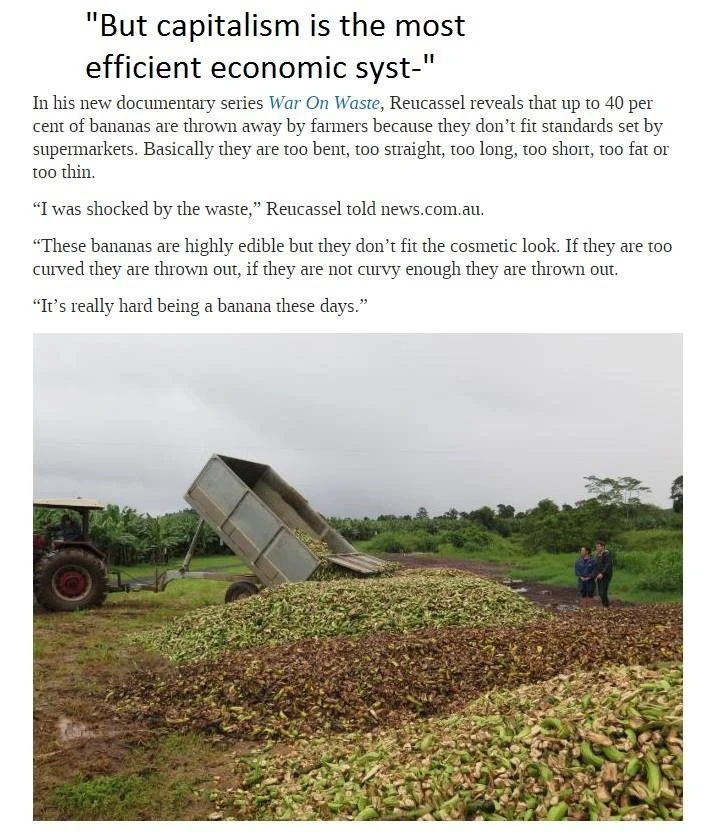
Bad logic because evidently it is so efficient it can waste things on visual standards alone… Lemmy lemmy lemmy what will we do with you…
The works of the roots of the vines, of the trees, must be destroyed to keep up the price, and this is the saddest, bitterest thing of all. Carloads of oranges dumped on the ground. The people came for miles to take the fruit, but this could not be. How would they buy oranges at twenty cents a dozen if they could drive out and pick them up? And men with hoses squirt kerosene on the oranges, and they are angry at the crime, angry at the people who have come to take the fruit. A million people hungry, needing the fruit- and kerosene sprayed over the golden mountains. And the smell of rot fills the country. Burn coffee for fuel in the ships. Burn corn to keep warm, it makes a hot fire. Dump potatoes in the rivers and place guards along the banks to keep the hungry people from fishing them out. Slaughter the pigs and bury them, and let the putrescence drip down into the earth.
There is a crime here that goes beyond denunciation. There is a sorrow here that weeping cannot symbolize. There is a failure here that topples all our success. The fertile earth, the straight tree rows, the sturdy trunks, and the ripe fruit. And children dying of pellagra must die because a profit cannot be taken from an orange. And coroners must fill in the certificate- died of malnutrition- because the food must rot, must be forced to rot. The people come with nets to fish for potatoes in the river, and the guards hold them back; they come in rattling cars to get the dumped oranges, but the kerosene is sprayed. And they stand still and watch the potatoes float by, listen to the screaming pigs being killed in a ditch and covered with quick-lime, watch the mountains of oranges slop down to a putrefying ooze; and in the eyes of the people there is the failure; and in the eyes of the hungry there is a growing wrath. In the souls of the people the grapes of wrath are filling and growing heavy, growing heavy for the vintage.
― John Steinbeck, The Grapes of Wrath
That really sucks but “highly edible” is a very funny phrase.
I am too, highly edible.
Exactly, nothing about capitalism is efficient and it never was. Capitalism is brutally effective at producing large quantities of stuff, but that doesn’t mean the waste is mitigated at all. In fact, the waste correlates with production.
Food waste is good so we have more stuff than we need. Otherwise when the next volcano erupts it’s famine time again (just look it up, it has happened at least 10 times during the last 2000 years and each time it caused a famine).
Example: https://en.wikipedia.org/wiki/Year_Without_a_Summer
That’s what a surplus is for not foodwaste.
Every food surplus is foodwaste and vice versa
Okay well you can go to the landfill and eat from there then you’ll never pay for food ever again
Definitely no.
Thankfully due to this show, at least Woolworths (Safeway) and maybe some other stores brought out a range of fruit and vegetables called “The Odd Bunch” that are cheaper and less “perfect”. It’s a small step, but at least it’s a start.
My city (in Canada) mostly has Save-On-Foods that sells “Not-So-Perfect” frozen blueberries which are a couple dollars cheaper than normal frozen blueberries. Pretty sure Thrifties (Sobeys) sells the same.
Loblaws has their “Naturally Imperfect” line.
And for those who don’t know Craig Reucassel is also one of the founding members of The Chaser satire team.
Totally separate from the capitalism part, isn’t composting a portion of what is grown to return nutrients and maintain soil health a thing? Along with crop rotation, I thought composting the unwanted or unusable products either through a feed-to-manure or organic waste composting method was part of healthy arable land management.
The capitalism part is certainly creating a larger “unwanted/unusable” percentage, but is there any information on how it is impacting overall land sustainability? Monocropping is 100% known to be killing farmland, so I am wondering what the current state of agricultural research is around this.
Totally separate from the capitalism part, isn’t composting a portion of what is grown to return nutrients and maintain soil health a thing?
Probably not the wisest behavior when there’s a fungal infection going around.
Are there actually people who think capitalism is efficient? Like sure it’s not Soviet level beaurocracy inefficiency but I wouldn’t stake my life saving medicine on this system if I had any other option
Capitalism is only efficient if it’s highly regulated. See the Scandinavian countries being successful at controlling capitalism.
Efficient at creating oligarchs and robber barons
Imagine if they actually sold the whole crop to stores. Bananas would be $0.10 a pound. You would never be hungry.
It wouldn’t decrease prices quite as much as you’d think, since so much of the cost of a banana is transportation, which they don’t do with the ones they throw out. They should still do it, obviously, and then transport them on trains to reduce transportation cost as well.
iirc transport on ship is actually cheaper than trains i think due to not needing rails and also ships being fucking huge which means low surface area to volume ratio, so you need less steel to build them.
also how do you build a train line from south america to europe?
I was comparing to the shipping via trucks that’s done in the US. You do of course need some other method to get them across oceans.
A really really big tunnel? It worked for the chunnel.
Fully automated luxury gay train communism!
Do you know where we can find data on this? The cost of each step that brings bananas to our homes.
See, you’ve found the issue they’re trying to avoid.
That and buyers preferring “pretty”/consistent produce, which means supermarkets only want to buy produce to spec because the other stuff won’t sell as well, shelf space is limited and it costs the supermarket more to waste unsold food than to just not buy food unlikely to sell. There are online markets out there that sell “ugly” produce that’s not to spec, but they aren’t broadly popular enough to make a huge dent in waste.
*buyers with money. Poor and hungry folk dont get a shit of the food isn’t the perfect shape.
So if I understand corrextly, if the bananas got into shops, they would just be thrown out later and with additional costs.
actually you know what … i would probably buy food that looks funny simply for the giggles in it … i’m kinda bored of normativity; “designers” (advertisement people) invent useless garbage new patterns all the time to “mix it up and keep it entertaining” … why not just use non-conformous food that naturally grows that way anyways?
Good old artificial scarcity
Bananas are already pretty cheap. I think they are the cheapest fruit in the grocery store.
id imagine there’s a demand for at minimum specialty stores that sell those 40% of bananas
My grocery store has a “imperfect produce” section, where they have funny shaped bananas, oranges that are not round, that sort of thing. Really cheap, and just as tasty.
It’s really crazy how cheap bananas are. They’re flown in from tropical countries and are at least half the cost of local in season produce. And they’re throwing away so many at every stage of production.
Bananas come by slow boat.
Assuming the front doesn’t fall off.
Yes, slow Banana boat.
Humans have produced enough food, and had the capability to feed every human in the world for over 500 years. Every famine you’ve seen in the news, all of them, has been caused by keeping food from being delivered to those that are hungry.
had the capability to feed every human in the world for over 500 years
Not 500, more like 120 or so years. First thanks to the invention of refrigerated logistics (essential for transporting foodstuffs without them spoiling during the trip) and then thanks to the Haber-Bosch process of extracting nitrogen from the atmosphere, which is essential for industrial fertilizers.
Famines since ~1930 could’ve been avoided if the “waste” surplus was redirected
We’ve moved preserved food since the discovery of salt. Transport, refrigeration and fertilizer technologies just let our population explode within the last century. The population levels prior to those technologies was more than supported by the transportation and food production capabilities of the time.
That’s just historically untrue. 500 years ago we didn’t have much of the technology needed for reliable harvest. Many farms were still highly dependant on rain. No rain, no crops. A late freeze, no crops. Locusts, no crops. You starve.That simple.
This doesn’t include the absolute necessity of artificial fertizlier in maintaining the modern population.
Maybe your statement could be true if we had the ability to move crops from areas not expirencing a disaster that could have fixed it, but would have been very difficult and required a global effort. So technically humanity may have produced enough food, but there was not a real way to move it. Even ignoring profit incentives that control logistics and assuming a altruistic system of redistribution, it could take weeks for messages to arrive in areas that did have food. Then it would take weeks to move it. No refrigeration, the fastest you could move is horse.
Seems very unlikely
The fastest you’d need to move is by horse or ship. Food preservation has been a thing since the discovery of salt. And we didn’t need artificial fertilizer centuries ago, because we didn’t need to support this many people on limited land, that’s a very recent problem. Also cities grew near water for a reason, that’s how they got their food. Ships moving food supplies.
Right so how are we increasing salt production? You’ll need more workers, which leaves less people available for farming. Could salt production even be scaled to match that demand given the technology? You’ll now need an increased network capacity to move the extra salt. More horses, more pots, more baskets, more drivers.
What about places without access by water?
Artificial fertilizer does however allow for a reliable surplus. Something necessary for a redistribution network. You need some kind of fertilizer and natural sources for scalable farming are rare.
You’ve created a fictional understanding of logistics that sums up to “just move the stuff” without considering the consequences.
You’re misunderstanding my statement, there is no need for increased production, because it already existed. There is no need for an expanded distribution system, it already existed. There is no need for more of anything, because it was already sitting there, just going to somewhere else. The only changes needed were which wagon, or which ship, the only consequences were who made how much profit, and who got credit for it.
Oh no I understand your statements, it’s just they are inherently wrong.
Honestly if you said in the last 200 years (maybe even 300) we wouldn’t be arguing. I think you’re severally over-estimating the surplus created by pre-industrial farmers and the amount of the economy engaged in luxury or profiteering. Most people then produced what they needed and little more. Yes there were portions of the economy tooled to serve the needs of the elite, but I’m not convinced that is enough labor to completely eliminate hunger even if redistributed to production and logistical networks.
We’re not even getting into how common slavery was for agricultural production. If we are creating a new system to ensure everyone is fed how do we deal with that?
I’ve made a simple historically verifiable statement, if you had any case what so ever, you’d be able to point to a counter example.
I’ve made a simple historically verifiable statement,
Can you provide a source then?
I’ve made a simple historically verifiable statement
You did the opposite. You insisted that your version was true and that re-tooling an entire supply chain is easy.
Your entire arguement is hypotheticals with no source.
I’d assume that intercontinental food shipping would have been rather difficult in the 1500s.
Swallows could grip it by the husk?
It’s not a question of where they grip it, it’s a simple matter of weight ratios!
Wouldn’t have been needed, production was distributed enough with populations. And crop collapses were contained to regional problems.
The grapes of wrath was written 100.years ago. The fact that capitalism is still considered the only solution (other than the state sanctioned anarchists like Chomsky) is testament to the concept that the ideas of any society are the ideas of the ruling class.
Lenin wrote about old capitalism vs new capitalism.
Yet we have people today claiming the same thing with 1950s-80s vs now.
who has sanctioned chomsky
Epstein apparently.
40% thrown away does not necessarily imply all others are better.
Normally imperfect produce goes to processing plants (juice, cans, pies etc.) but I’m not sure if there’s any significant market for banana chunks/puree.
There are some frozen fruit mixes that use banana chunks. Also some that use frozen puree in pre-measured shapes.
Banana juice is a thing, and banana chips and such. Probably too small of a market to repurpose all the uncool bananas :/
baby food maybe?
They figured out ways to cram all the subsidized surplus soy and almonds nobody wants into every conceivable product, they could certainly manage to do so with ugly bananas.
Animal feed as well.
“The works of the roots of the vines, of the trees, must be destroyed to keep up the price, and this is the saddest, bitterest thing of all,” Steinbeck wrote. “Carloads of oranges dumped on the ground…a million people hungry, needing the fruit — and kerosene sprayed over the golden mountains.”
Finally read this book last week. Needs to be a required read for every human. Basically every sentence had me nodding furiously in agreement . really shows how fucking evil rich people are even back then when they had WAYYYYYYYYYYY less than they do now.
But if you read Steinbeck you might have a spark of empathy or introspection and we can’t have that. Or even have thoughts about socialism, gasp! God forbid.
Ha exactly. I told my friend who is a big Rand fan they need to read it.
I actually like Rands books myself. But the ideology falls apart with a modicum of introspection.
I’d recommend east of Eden and winter of our discontent as well. Especially the latter if you’re in the US.
Gonna get those for sure
What book is this? Sounds like something Steinbeck would write.
Grapes of Wrath. Good catch, as he wrote that book!
Last time, I was in the store, the last non-Chiquita bananas were two bunches with basically half-sized bananas.
And well, it did cross my mind that I’m basically paying extra for the “packaging” that way, as they have almost more peel than pulp. (The bigger the banana[1] the less surface area it has, relative to the volume.)
But on the other hand, I can portion those small bananas better, so there’s ups and downs, for sure. Which means, it’s actually quite fair that they have some smaller bananas in the store, too.
Or any other object. ↩︎
You’re going to piss off a lot of mathematicians with that footnote lol
Hmm, interesting. For what object is this not correct? And does it exist in Euclidian 3D space? 😅
For daily objects, something like a sponge, or even a shape like a waffle can increase surface area while reducing volume
A tetrix is a fractal-like object that approaches zero volume and keeps the same surface area as the number of iterations increase. (I only know about it because I saw a 3d printable version of it on a YT video the other day).
Yes, but at a set number of iterations, scaling the object will cause volume to grow faster proportionally than surface area.
Depends on how you define bigger and object. Picture a sea urchin, if the spikes get longer without the center growing…